
Temperature vs Humidity vs Stability Chamber: Differences, Specifications and Applications
Jay Pal Singh
19 October 2026
Humidity and Temperature Conditioning Chamber
Temperature and Humidity Chamber
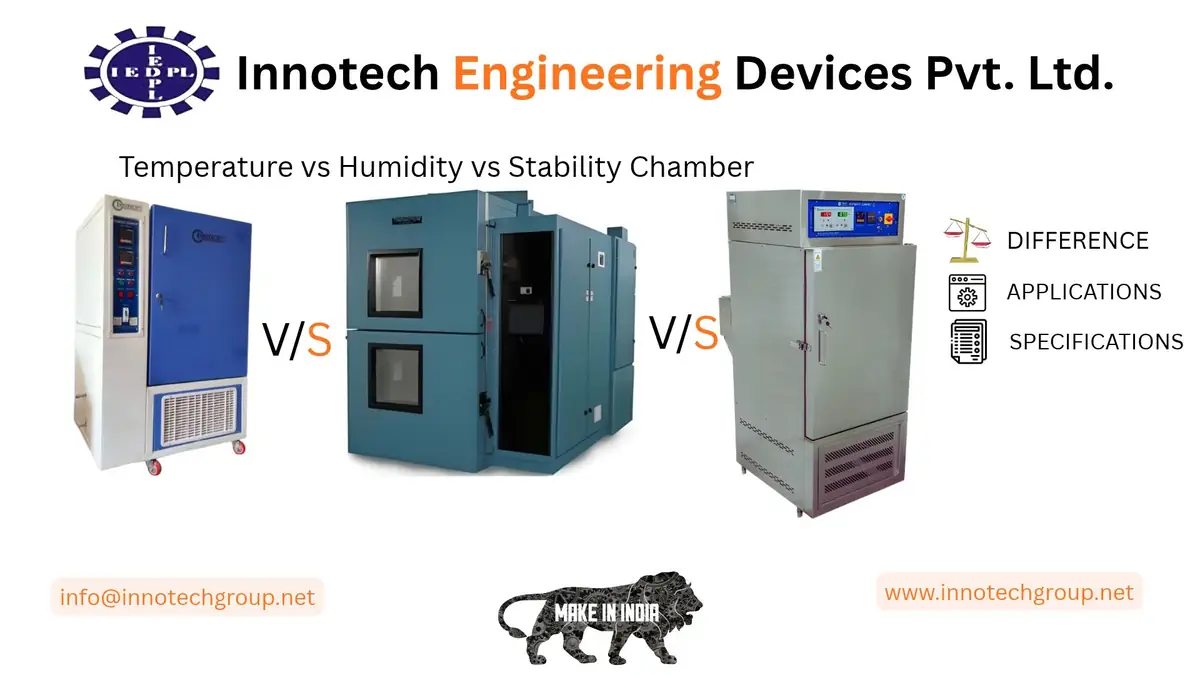
Temperature vs Humidity vs Stability Chamber: Differences, Specifications and Applications
Choosing the right environmental testing chamber is important for evaluating product quality, durability, reliability and stability under controlled conditions. Temperature chambers, humidity chambers and stability chambers are used across different industries, but their operating principles, specifications and testing applications are not the same.
A Temperature Chamber is primarily used to evaluate the effects of high and low temperatures on materials and components. A Humidity Chamber controls relative humidity and often temperature to study the effects of moisture on products. A Stability Chamber is mainly designed for long-term and accelerated stability studies, particularly in pharmaceutical and medicine manufacturing.
In this guide, we compare temperature vs humidity vs stability chambers, including their specifications, applications, suitable tests and important factors to consider before purchasing environmental testing equipment.
1. What Is a Temperature Chamber?
A Temperature Chamber is a laboratory testing machine designed to expose materials, components and finished products to controlled high or low temperatures. It helps manufacturers determine how temperature variations affect product performance, physical properties, dimensions and reliability.
Temperature chambers are widely used in automotive, electronics, electrical, plastics, rubber and material testing laboratories. Depending on the model, they may provide programmable heating, refrigeration, temperature cycling and data recording.
For example, an automotive manufacturer may use a temperature chamber to check whether a plastic dashboard component becomes brittle at low temperatures or deforms when exposed to heat.
Typical Temperature Chamber Specifications
| Specification |
Typical Configuration |
| Temperature range | Example: -40°C to +150°C |
| Humidity control | Generally not available in temperature-only models |
| Temperature accuracy | Model-dependent |
| Temperature uniformity | Depends on chamber design and loading |
| Controller | digital PID or programmable touchscreen |
| Air circulation | Forced-air circulation in many models |
| Chamber capacity | Benchtop, floor-standing or customised |
| Data logging | Optional or integrated, depending on model |
These are illustrative specifications. Actual operating limits, accuracy and uniformity should be confirmed from the manufacturer's datasheet.
Applications of a Temperature Chamber
- High-temperature and low-temperature exposure testing
- Thermal cycling of electrical and electronic components
- Heat resistance testing of plastic and rubber products
- Temperature conditioning of industrial materials
- Automotive component reliability testing
- Evaluation of temperature-related dimensional changes
Suitable for: Automotive components, electrical products, electronics, polymers, rubber products and industrial materials.
Explore the product: [Temperature Chamber]
2. What Is a Humidity Chamber?
A Humidity Chamber is used to control relative humidity (RH) and, in many models, temperature simultaneously. It helps determine how moisture affects a product's durability, dimensions, appearance, electrical performance and resistance to environmental exposure.
Temperature-humidity chambers are particularly useful when a test requires controlled combinations of heat and moisture. For example, electronic components may be exposed to elevated temperature and humidity to evaluate moisture-related reliability problems.
Typical Humidity Chamber Specifications
| Specification |
Typical Configuration |
| Temperature range | Example: -40°C to +150°C in selected models |
| Relative humidity range | Example: 20-95% RH or another model-specific range |
| Humidity control | Humidification and, where supported, dehumidification |
| Temperature control | Programmable heating and cooling |
| Humidity sensor | Model-dependent RH sensing system |
| Controller | Programmable digital controller |
| Air circulation | Forced-air circulation in many models |
Important: The full temperature range and full humidity range may not be achievable simultaneously. The specified RH operating envelope must be checked before selecting the equipment.
Applications of a Humidity Chamber
- Damp-heat testing of electronic components
- Moisture resistance testing of coatings and materials
- Humidity conditioning of packaging and paper products
- Environmental durability testing of automotive components
- Temperature-humidity cycling
- Evaluation of moisture-related changes in plastics and rubber
Suitable for: Electronics, automotive suppliers, packaging manufacturers, coatings industries and material testing laboratories.
Explore the product: [Temperature-Humidity Chamber]
3. What Is a Stability Chamber?
A Stability Chamber is an environmental testing machine designed primarily to maintain specified temperature and humidity conditions over extended periods. It is commonly used in pharmaceutical laboratories to evaluate the stability, quality and shelf life of medicines, active pharmaceutical ingredients (APIs), tablets, capsules and other drug formulations.
Unlike a general-purpose temperature chamber, a stability chamber is generally configured for sustained environmental conditions, continuous monitoring, alarms and documented records. Depending on the application, additional requirements may include qualification, calibration, temperature and humidity mapping, electronic records and audit trails.
Typical Stability Chamber Specifications
| Specification |
Typical Configuration |
| Temperature control | Designed around the required stability-study conditions |
| Relative humidity control | Configured for the specified RH setpoints |
| Common study condtions | Examples include 25°C/60% RH and 40°C/75% RH |
| Controller | Programmable digital controller |
| Monitoring | Continuous temperature and RH monitoring, as specified |
| Alarms | Configurable alarms, depending on model |
| Data logging | Required functionality depends on the application |
| Qualification support | Available according to supplier offering and project requirements |
The listed conditions are examples, not universal requirements. Applicable regulatory guidance, product characteristics and the approved stability protocol determine the correct settings.
Applications of a Stability Chamber
- Long-term pharmaceutical stability studies
- Accelerated stability studies
- Intermediate stability studies, where applicable
- Stability testing of tablets, capsules and syrups
- Evaluation of APIs and finished pharmaceutical products
- Studies supporting product shelf life and retest periods
Suitable for: Pharmaceutical manufacturers, drug development laboratories, contract research organisations and pharmaceutical quality-control departments.
Explore the product: [Stability Chamber]
4. Temperature vs Humidity vs Stability Chamber: Comparison Table
The primary difference between these machines is the environmental condition they are designed to control and the type of test they support.
| Comparison Parameter |
Temperature Chamber |
Humidity Chamber |
Stability Chamber |
| Primary purpose | Temperature exposure testing | Moisture and climatic testing | Long-term and accelerataed stability studies |
| Temperature control | Yes | Yes, in combined models | Yes |
| Humidity control | Usually not included | Yes | Yes, as configued |
| Temperature cycling | Supported if programmed | Supported if programmed | Depends on model and protocol |
| Moisture resistance testing | Not suitable without humidity control | Suitable for applicable methods | Possible if configured appropriately |
| Pharmaceutical stability testing | For specific temperature-only protocols | Possible if all requirements are met | Primary applications |
| Automotive testing | Suitable for temperature exposure | Suitable for combined climatic exposure | Generally not the first choice |
| Electronics testing | Suitable for temperature-related tests | Suitable for humidity-related tests | Generally not the first choice |
| Continous monitoring | Model-dependent | Model-dependent | Commonly required for regulated studies |
A chamber should be selected according to the required test method, exposure duration and acceptance criteria. Similar temperature ranges do not mean that two chambers are interchangeable.
5. Technical Specifications Comparison
Before purchasing an environmental testing chamber, compare the technical parameters that directly affect the intended application.
| Technical Parameter |
Temperature Chamber |
Humidity Chamber |
Stability Chamber |
| Temperature range | Based on thermal test requirements | Based on combined temperature and RH requirements | Based on stability-study protocol |
| RH operating range | Usually not applicable | Critical specification | Critical specification |
| Temperature accuracy | Important | Important | Important |
| Temperature uniformity | important | important | important |
| Humidity uniformity | Not applicable to standard models | Important | important |
| Chamber volume | Based on sample dimensions and quantity | Based on sample dimensions and quantity | Based on study capacity |
| Programmable profiles | Useful for thermal cycles | Useful for climatic cycles | Useful for setting study conditions |
| Monitoring and alarms | Application-dependent | Application-dependent | Particularly important for prolonged studies |
| Data records | Depends on test requirements | Depends on test requirements | Must meet applicable quality requirements |
Temperature accuracy and temperature uniformity are different parameters. Accuracy indicates how closely a measured temperature corresponds to the intended value, while uniformity describes variation across different locations in the working space.
Similarly, humidity control should be evaluated at the actual temperature and RH combination required by the test, not just by the maximum RH advertised.
6. Which Chamber Is Used in Which Industry?
Automotive Industry
Temperature chambers are used to evaluate heat resistance, cold resistance and temperature-related performance changes in automotive components. Temperature-humidity chambers are preferred when moisture exposure is also part of the test protocol.
Electronics and Electrical Industry
Temperature chambers are suitable for thermal cycling and temperature exposure. Humidity chambers are used for damp-heat exposure and moisture-related reliability testing of circuit boards, connectors and electrical components.
Pharmaceutical Industry
Stability chambers are generally preferred for long-term and accelerated pharmaceutical stability studies. These studies require defined environmental conditions, monitoring and documentation appropriate to the applicable protocol and quality system.
Packaging and Paper Industry
Humidity chambers are useful for conditioning packaging materials and assessing moisture-related changes in paperboard, labels, packaging components and other hygroscopic materials.
Plastics and Rubber Industry
Temperature chambers are suitable for evaluating heat and cold resistance. Humidity chambers may be needed when the test procedure includes moisture exposure or combined climatic conditioning.
7. Common Pharmaceutical Stability Testing Conditions
Pharmaceutical stability studies use conditions defined by the applicable guidance and approved study protocol. Commonly referenced examples include:
| Study Conditions |
Temperature |
Relative Humidity |
| Long-term condition | 25°C | 60% RH |
| Alternative long-term condition | 30°C | 65% RH |
| Accelerated condition | 40°C | 75% RH |
These are illustrative conditions associated with commonly used pharmaceutical stability guidance. The correct conditions depend on the product, packaging, intended market and applicable requirements.
When selecting a pharmaceutical stability chamber, confirm its ability to maintain the required temperature and humidity under the intended sample load. Check environmental monitoring, alarms, data retention, calibration, mapping and qualification documentation before purchasing.
8. How to Choose the Right Environmental Testing Chamber
Follow these steps before selecting equipment:
1. Define the test objective: Determine whether you need temperature exposure, humidity testing or a long-term stability study.
2. Confirm the required conditions: Identify the minimum and maximum temperatures, RH setpoints and exposure duration.
3. Check chamber capacity: Ensure that the working volume accommodates the samples without obstructing airflow.
4. Review performance specifications: Compare accuracy, uniformity, recovery performance and the operating envelope.
5. Evaluate monitoring and records: Determine whether continuous monitoring, alarms, data logging and electronic records are required.
6. Confirm the testing standard: Match the machine's capabilities to the applicable test method and quality requirements.
For pharmaceutical applications, qualification and documentation may be as important as temperature and humidity control.
9. Frequently Asked Questions
What is the difference between a temperature chamber and a humidity chamber?
A temperature chamber primarily controls temperature, while a humidity chamber controls relative humidity and commonly temperature as well. Select the humidity chamber when the testing procedure requires controlled moisture exposure.
Can a humidity chamber be used as a stability chamber?
A humidity chamber may be suitable if it meets the required stability-study conditions, environmental uniformity, monitoring, qualification and documentation requirements. A general-purpose humidity chamber should not automatically be considered suitable for regulated pharmaceutical testing.
Which chamber is best for pharmaceutical stability testing?
A stability chamber designed and qualified for the applicable pharmaceutical protocol is generally the preferred choice for long-term and accelerated stability studies.
Which chamber is suitable for automotive testing?
A temperature chamber is suitable for temperature-only tests, while a temperature-humidity chamber is more suitable when both temperature and humidity must be controlled.
What specifications should I check before buying?
Check temperature range, relative humidity range, accuracy, uniformity, chamber volume, controller programming, monitoring, data logging, alarms, calibration requirements and the relevant test standard.
Conclusion
Temperature chambers, humidity chambers and stability chambers serve different environmental testing requirements. A temperature chamber is suitable for heat and cold exposure, a humidity chamber is appropriate for moisture and combined temperature-humidity testing, and a stability chamber is primarily designed for sustained stability studies, especially in pharmaceutical applications.
The right machine depends on your test method, environmental conditions, sample quantity, monitoring requirements and applicable standards. Compare the technical specifications carefully before purchasing.
For environmental testing equipment and laboratory solutions, visit Innotech Engineering Devices Pvt. Ltd. at https://innotechgroup.net/ to explore available products and discuss your testing requirements with the technical team.
Category: Test Chambers
Tags: Temperature vs Humidity vs Stability Chamber, Temperature Chamber vs Humidity Chamber, Temperature Chamber vs Stability Chamber, Humidity Chamber vs Stability Chamber, Temperature Chamber, Humidity Chamber, Stability Chamber, Temperature Humidity Chamber,
Last Updated: 19 October 2026