
Why Is a Universal Testing Machine Important Today? Types, Uses and Applications
Jay Pal Singh
21 October 2026
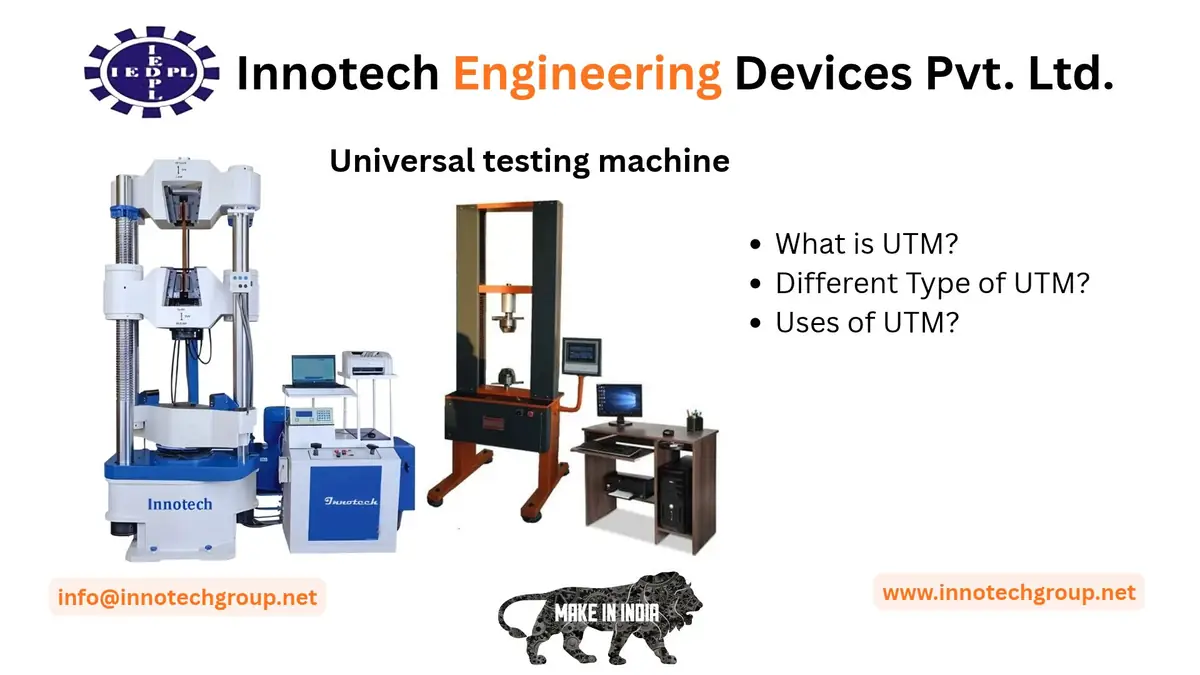
Why Is a Universal Testing Machine Important Today? Types, Uses and Applications
A Universal Testing Machine (UTM) is an essential piece of equipment for manufacturers, quality control laboratories, research centres and material testing facilities that need to evaluate the mechanical properties of materials. If your business needs to measure tensile strength, compressive strength, elongation, or other mechanical properties, choosing the right Universal Testing Machine can help improve product quality, verify material performance and support quality control.
Universal Testing Machines are widely used for testing metals, plastics, rubber, wires, cables, textiles, and other materials, depending on the machine capacity, grips, fixtures and testing configuration. From raw material inspection to finished-product validation, a UTM helps engineers understand how a material behaves under an applied force.
Innotech Engineering Devices Private Limited offers Universal Testing Machine solutions for industrial and laboratory applications, with configurations selected according to customer testing requirements. If you are looking for a Universal Testing Machine in India, understanding its importance, types, working principle and applications can help you make a better purchasing decision.
What Is a Universal Testing Machine?
A Universal Testing Machine is a mechanical testing system used to determine how a material or component responds when a controlled force is applied. Depending on its configuration and accessories, the machine can perform tensile, compression, bending, and other mechanical tests.
During testing, the machine applies a load to a specimen while measuring relevant parameters such as force and displacement. Additional measurements, including elongation and strain, may be available when suitable extensometers or other measurement devices are used.
The results help manufacturers and engineers evaluate whether a material meets the required specifications, product design requirements or applicable testing standards.
Why Is a Universal Testing Machine Important Today?
As industries focus on consistent product quality, material performance and reliable testing, Universal Testing Machines play an important role in manufacturing and laboratory operations.
1. Quality Control and Product Reliability
A product may look correct but still fail when subjected to tension, compression or bending. A UTM helps identify mechanical weaknesses before materials or components move to the next stage of production.
Regular material testing can help manufacturers maintain consistent quality and investigate unexpected failures.
2. Measuring Material Strength
A Universal Testing Machine helps determine important mechanical properties, depending on the test method and accessories used.
These may include:
- Tensile strength
- Compression strength
- Yield strength
- Elongation at break
- Young's modulus, when suitable measurements and calculations are available
- Flexural strength or bending behaviour
- Load and displacement response
Not every machine measures every property automatically. The selected test method, software, fixtures and measurement devices determine which results can be obtained.
3. Supporting Manufacturing Quality Standards
Manufacturers often need to verify that materials meet internal quality requirements, customer specifications or relevant industry standards.
A properly configured UTM can support testing procedures based on applicable standards. The correct machine capacity, calibration status, grips, specimen dimensions and test method must be selected for the required standard.
4. Reducing the Risk of Material Failure
Testing helps engineers understand how materials respond to loading before they are used in actual products. This is important for components that experience repeated handling, mechanical forces or demanding service conditions.
UTM results can support material selection, product development and failure investigations. However, a laboratory test alone cannot guarantee that a finished product will never fail in service.
5. Improving Research and Product Development
Research laboratories use Universal Testing Machines to compare materials, study new formulations, validate design changes and evaluate prototypes.
For example, a manufacturer developing a new plastic component may compare the tensile strength and elongation of several material grades before selecting one for production.
6. Supporting Supplier and Incoming Material Inspection
A UTM can help a quality team check whether incoming raw materials meet the agreed mechanical requirements. This can be useful when comparing material batches, evaluating suppliers or investigating inconsistent production results.
7. Enabling Better Testing Documentation
Depending on the model and software, a UTM may record load, displacement, elongation and test curves. Digital data logging can help laboratories maintain records, compare results and prepare test reports.
The available reporting and communication features depend on the selected machine configuration.
Types of Universal Testing Machines
Universal Testing Machines are available in different designs. They can be classified by drive mechanism, frame construction, control system, load capacity and intended application. These classifications overlap, so a machine may belong to more than one category.
1. Electromechanical Universal Testing Machine
An electromechanical UTM typically uses an electric motor and a mechanical transmission system to move the crosshead and apply force to the specimen.
Key characteristics:
- Suitable for many routine material testing applications'
- Available in different load capacities
- Can be configured for tensile, compression and bending tests
- May use digital or computer-based controls, depending on the model
Applications: Metals, plastics, rubber, wires, cables and other materials when the machine capacity and accessories are appropriate.
Electromechanical machines are commonly considered by laboratories and manufacturers that require controlled material testing for quality assurance, production checks or research.
2. Servo-Controlled Universal Testing Machine
A servo-controlled UTM uses a control system to regulate the testing process. The specific drive technology can vary, so buyers should confirm whether a proposed machine is servo-electric or servo-hydraulic.
Depending on the design, the system may provide controlled movement, load control, displacement control or other programmed testing modes.
Key characteristics:
- Controlled test movement and loading
- Potential for programmable test sequences
- Digital monitoring and data acquisition, depending on configuration
- Options for different grips, fixtures and extensometers
Applications: Industrial laboratories, engineering research, production quality control and testing procedures that require specific control modes.
When choosing a servo-controlled UTM, confirm the control modes, accuracy requirements, software functions and test standards required for your application.
3. Hydraulic Universal Testing Machine
A hydraulic UTM uses hydraulic pressure to generate the force required for testing. Hydraulic systems are commonly used in machines designed for higher load capacities.
Key characteristics:
- Suitable for high-force testing when appropriately designed
- Available in different capacities and frame arrangements
- Can be configured for tensile and compression testing
- May support additional tests through suitable accessories
Applications: Metal testing, structural materials, heavy engineering components and other applications that require substantial test forces.
The correct hydraulic capacity should be chosen according to the maximum expected test load, specimen dimensions and applicable testing standards.
4. Computerised Universal Testing Machine
A computerised UTM uses software and a data acquisition system to monitor and record test information. Computerisation is a control and data-management feature rather than a separate drive mechanism.
Depending on the configuration, the system may display load, displacement, elongation, test curves and calculated material properties.
Key characteristics:
- Digital test monitoring
- Test data recording and report generation
- Graphical presentation of results
- Potential for saving and comparing test records
Applications: Quality control laboratories, research institutions, material testing laboratories and manufacturing facilities that require documented test results.
Before purchasing, check the software's reporting features, available test methods, data export options and compatibility with your laboratory's procedures.
5. Universal Testing Machine with Digital or Touch-Screen Controls
Some UTMs use digital control panels or touch-screen interfaces to configure and monitor tests. This describes the user interface and does not necessarily indicate a particular drive mechanism.
Key characteristics:
- Digital display of relevant test parameters
- Easier access to supported test settings
- Possible storage of test results, depending on the model
- Integration with other measurement and control features when specified
Applications: Laboratories and production facilities that prefer digital operation and structured test monitoring.
The actual functions available vary between models. Buyers should verify the interface, control modes and reporting capabilities before finalising a machine.
Universal Testing Machine Types: Quick Comparison
| Type |
Main Characteristic |
Common selection reason |
| Electromechanical UTM | Electric motor-driven crosshead | Routine material testing and laboratory use |
| Servo-controlled UTM | Controlled testing process | Applications requiring specific loading or movement control |
| Hydraulic UTM | Hydraullic force generation | Higher-load testing requirements |
| Computerised UTM | Software-based monitoring and data recording | Digital analysis and test documentation |
| Digital or touch screen UTM | Digital operating interface | Convenient test setup and monitoring |
These categories are not mutually exclusive. For example, an electromechanical UTM can also be servo-controlled and computerised. Select a machine based on its complete technical specification rather than its category name alone.
How Does a Universal Testing Machine Work?
The exact procedure depends on the test method, specimen and machine configuration. A typical test follows these steps:
1. Prepare the specimen: Prepare the test sample according to the relevant test method and standard.
2. Select the test setup: Choose suitable grips, compression platens, bending fixtures or other required accessories.
3. Mount the specimen: Secure the sample correctly to minimise slipping, misalignment or unwanted loading.
4. Configure the test: Set the required test parameters, such as test speed, load limits and measurement settings, as supported by the machine.
5. Apply the load: The machine applies a controlled force while the relevant measurements are recorded.
6. Review the results: Examine the recorded data, graph and calculated properties supported by the system.
7. Prepare the report: Save or export results where the software supports reporting.
Correct specimen preparation, alignment, calibration and selection of the appropriate test method are essential for meaningful results.
Industrial Applications of Universal Testing Machines
Universal Testing Machines are used across many industries. The suitable machine and test setup depend on the material, specimen dimensions, expected force and required test method.
Automotive Industry
Used to evaluate mechanical properties of selected metal, plastic, rubber and other automotive materials or components.
Metal and Steel Industry
Used for tensile testing and other supported tests on metal specimens, helping assess strength and deformation behaviour.
Plastic and Polymer Industry
Used to evaluate properties such as tensile strength, elongation and selected compression or bending characteristics.
Construction and Building Materials
Used for testing suitable construction materials and components. Dedicated compression testing machines may be more appropriate for certain high-load concrete or cement specimen tests.
Wire and Cable Industry
Used to evaluate tensile behaviour and related mechanical properties of suitable wire and cable specimens with the correct grips and fixtures.
Textile and Packaging Industry
Used for selected tensile, tear, peel or related tests when the machine and test accessories are designed for the relevant procedure.
Research and Educational Laboratories
Used for material comparison, engineering experiments, product development and teaching mechanical testing principles.
Universal Testing Machine vs Dedicated Testing Machine
A Universal Testing Machine offers flexibility, but it is not automatically the best option for every testing requirement.
| Feature |
Universal Testing Machine | Dedicated testing machine |
| Testing Scope | Can support multiple test type with suitable fixtures | Designed around a particular test or application |
| Flexibility | Generally higher when configured appropriately | Usually focused on its intended test |
| Accessories | May require changing grips or fixtures | Often uses a test-specific arrangement |
| Laboratory use | Useful for multiple material testing requirements | Useful for repetitive or specialised test |
| Selection priority | Versatility and supported test methods | Specific application, throughout and test requirements |
If your laboratory performs several different mechanical tests, a UTM may provide useful flexibility. If you perform one specialised test repeatedly or need a particular high-load setup, a dedicated machine may be more suitable.
How to Choose the Right Universal Testing Machine
Before purchasing a UTM, evaluate the following points:
1. Required load capacity: Estimate the maximum expected force based on your specimens and test procedures. Avoid selecting capacity based only on a general industry category.
2. Material type: Consider whether you will test metals, plastics, rubber, wires, textiles or other materials.
3. Test methods: Identify whether you require tensile, compression, bending or other tests. Confirm that the machine supports each method with suitable accessories.
4. Accuracy and measurement range: Check the applicable accuracy requirements, force measurement range, displacement measurement and any extensometer requirements.
5. Control system: Determine whether manual, digital, computerised or servo-controlled operation best matches your testing needs.
6. Software and reporting: Check whether the machine provides the required graphs, calculations, saved results and report formats.
7. Testing standards: Confirm the relevant ASTM, ISO, BIS or other applicable standards and verify that the complete machine configuration supports your test procedure.
8. Fixtures and grips: Select suitable accessories for your specimen shape, dimensions and material.
9. Calibration and after-sales support: Ask about calibration requirements, service availability, installation, training and technical support.
10. Budget and customisation: Compare the complete proposed configuration, including accessories, software, installation and other required items, rather than comparing base machine prices alone.
Universal Testing Machine Price in India
The price of a Universal Testing Machine in India depends on several factors, including load capacity, frame design, drive mechanism, control system, accuracy requirements, software, grips, fixtures and additional measurement devices.
A basic configuration for routine testing will not necessarily cost the same as a high-capacity servo-controlled system with advanced software and application-specific accessories. Therefore, a reliable price comparison should be based on the same technical requirements and included equipment.
For an accurate quotation, share your material type, required test methods, expected maximum load, specimen dimensions and any applicable testing standard with the manufacturer.
Universal Testing Machine Solutions from Innotech Engineering Devices
Innotech Engineering Devices Private Limited provides material testing equipment for industrial and laboratory applications. The suitable Universal Testing Machine configuration depends on the customer's test requirements, material type, load capacity and desired features.
Explore our [Servo Control Electro Mechanical Universal Testing Machine – 200 kN](https://innotechgroup.net/products/servo-control-electro-mechanical-universal-testing-machine-200kn) to learn more about one of our UTM offerings.
Contact our team to discuss your application, required accessories, testing specifications and machine configuration.
Innotech Engineering Devices Private Limited
- Website: https://innotechgroup.net
- Email: info@innotechgroup.net
- Phone: +91 9810431604
- Location: H-307, RIICO Industrial Area, Karoli, Tapukara, Bhiwadi, Rajasthan, India
Frequently Asked Questions
1. What is the main purpose of a Universal Testing Machine?
Its main purpose is to evaluate the mechanical behaviour of materials under an applied force, including tensile, compression and other supported tests.
2. What are the main types of Universal Testing Machines?
Common classifications include electromechanical, hydraulic, servo-controlled, computerised and digital or touch-screen models. These categories can overlap.
3. Which materials can be tested using a UTM?
Depending on capacity and configuration, UTMs can test metals, plastics, rubber, wires, cables, textiles and other suitable materials.
4. Can a Universal Testing Machine perform both tensile and compression tests?
Yes, many UTMs can perform both tests when supplied with the appropriate grips, platens, fixtures and control functions.
5. What is the difference between a hydraulic and an electromechanical UTM?
A hydraulic UTM generates force through a hydraulic system, while an electromechanical UTM typically uses an electric motor and mechanical transmission. The best choice depends on required capacity and application.
6. What is the difference between a computerised and a manual UTM?
A computerised model can use software to monitor, record and analyse test data. The functions of a manual or digital model depend on its control and measurement configuration.
7. How do I select the correct UTM capacity?
Select capacity according to the expected maximum test force, specimen dimensions, required accuracy and applicable test method. A manufacturer can help evaluate these requirements.
8. What affects the price of a Universal Testing Machine in India?
Capacity, control system, software, measurement devices, grips, fixtures, accuracy requirements and installation or service needs can all affect the final quotation.
9. Does every Universal Testing Machine support every material test?
No. The supported tests depend on the machine design, load capacity, fixtures, measurement devices, software and relevant test requirements.
Conclusion
A Universal Testing Machine is an important tool for material evaluation, quality control, product development and industrial testing. Different machine designs support different load capacities, control methods and testing needs. Understanding these differences helps buyers select equipment that matches their materials, test methods and budget.
Before purchasing, review the required capacity, accuracy, fixtures, software and applicable standards. Contact Innotech Engineering Devices to discuss a Universal Testing Machine configuration suited to your testing requirements.
Category: Industrial Testing Machines / Material Testing
Tags: Universal Testing Machine, UTM Machine, UTM Testing Machine, Universal Tensile Testing Machine, Universal Testing Machine India, Universal Testing Machine Suppliers, Universal Testing Machine Price,
Last Updated: 22 October 2026